handnet
handnet — neural networks with hand-written weights
Networks whose weights are designed, not trained. The architecture is an ordinary neural network (embeddings, convolutions, recurrences, MLPs, ReLUs) and it runs in numpy or PyTorch like any other, but every non-zero weight was placed by reasoning about the task. The result is a model that is readable, auditable, deterministic, needs no data and no GPU, and is still a real network you can fine-tune, distil into, or compare against a trained one.
The project collects such networks, documents how to build them, and measures how far the approach carries.
| Network | Task | Params | Non-zero | Headline result |
|---|---|---|---|---|
handnet/text_quality.py |
text quality 0–100, any language | 100,331 | 627 | mean AUC 0.907 kept-vs-removed FineWeb-2 docs, 33 languages / 11 scripts (0.82–0.98) |
handnet/sentiment.py |
positive/negative, SST-2 | 9,146 | 1,567 | 78.6% test with 0 labels seen, 79.2% after one revision; beats logistic regression trained on 2,048 sentences |
handnet/mnist.py |
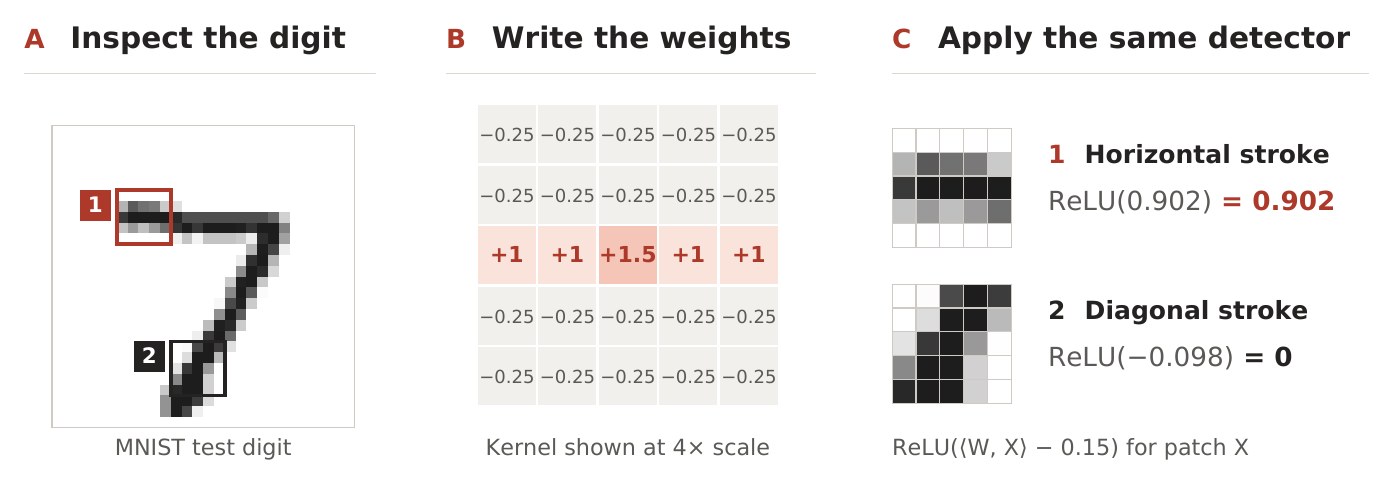
handwritten digits | 28,234 | 662 ink pixels | 55.4% blind, 79.4% after two revisions ≈ a classifier trained on 200 images — here training wins |
handnet/mnist_holes.py |
handwritten digits, second design: stroke kernels + recurrent hole finder + 5×5 sketches + named evidence | 21,772 | 2,411 | 83.3% test; thresholds and votes set by hand after reading feature means and confusion matrices on 5,000 training images (not blind); beats a trained nearest-class-mean (81.6%) |
handnet/transformer.py |
transformers: addition with carry, Dyck-1 brackets, induction/copy — attention heads written by hand | 2,851 / 654 / 25,336 | 405 / 26 / 278 | 100% exact on all three with 0 labels; trained twins need ~1k examples (addition, Dyck) and more for induction |
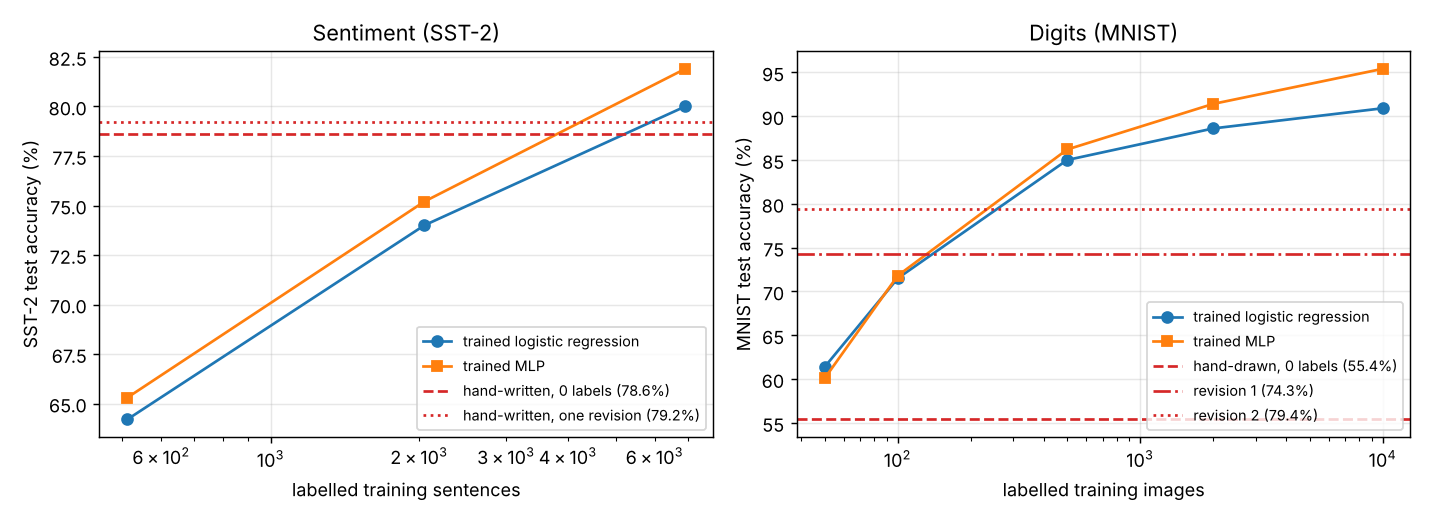
The sentiment and MNIST networks were written by Claude Fable 5.1 under a strict protocol (blind write → sealed test set → bounded revisions, each reported with the labels it looked at → trained baselines at matched label counts). Hand-writing wins where the features are nameable (words, negation, markup, mojibake) and loses where they are statistical regularities in pixel space. See METHOD.md §7.
Site with all results and a live in-browser demo of the text and digit networks: https://birgermoell.github.io/handnet/ ·
paper: paper/main.pdf.
More networks are being added; see COORDINATION.md for what is in progress and how to add one.
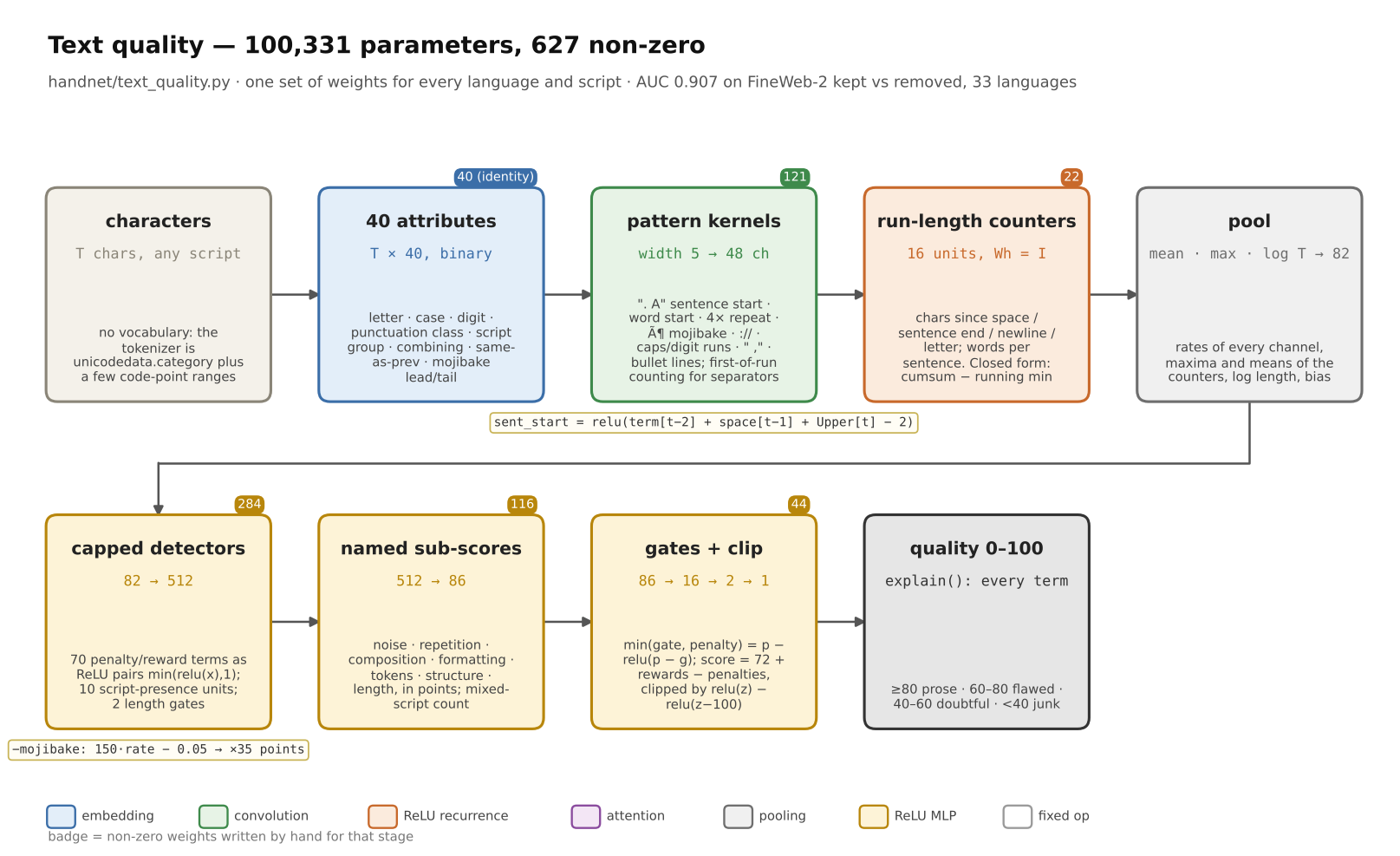
Architecture figures for every network: docs/architectures (source examples/figures/architectures.py).
Quick start
git clone https://github.com/BirgerMoell/handnet && cd handnet
pip install numpy            # the only runtime dependency
python -m pytest -q tests

python examples/sentiment/eval_sst2.py      # SST-2: 79.2% test, 81.4% dev
python examples/mnist/eval_mnist.py         # MNIST: 79.4% test
python examples/sentiment/baselines_sst2.py # trained rows (pip install scikit-learn)
python examples/mnist/baselines_mnist.py

python - <<'EOF'
from handnet import sentiment, mnist
print(sentiment.score("not a bad film at all"))        # 0.615
print(sentiment.explain("it is never boring"))
from handnet.text_quality import HandNet
net = HandNet()
print(net.n_params, net.n_nonzero)                    # 100331 627
print(net.score("Hunden springer i parken. Den är glad och leker."))
print(net.explain("<div><ul><li>Home</li></ul></div> |||| ===="))
# {'score': 24.7, 'base': 72.0, '-markup': 20.0, '-few_letters': 11.3, ...}

from handnet.mnist_holes import MNISTNet
import numpy as np
img = np.zeros((28, 28)); img[5:23, 13:16] = 1.0          # a vertical bar
print(MNISTNet().predict(img), MNISTNet().explain(img))   # 1, with the evidence
EOF
How this repo was made
Both networks were written by Claude (Anthropic’s Claude Fable 5.1) in conversation with Birger Moëll, who
set the tasks, the rule and the standard of evidence, across several parallel threads on 4 November 2026
(see COORDINATION.md). The rule: a weight may be set by reasoning (“clean prose has about one sentence
end per hundred characters”, “a 4 has an empty top centre”) and checked against data, but never fit to
data — no gradients, no optimiser, no search over weight values. Every non-zero weight is in the source next
to the unit it belongs to, and each network’s example README states exactly what “checked against data”
meant for it (for MNIST: class-conditional feature means and confusion matrices on 5,000 training images;
test set scored once). METHOD.md is the how-to for writing your own.
Why hand-written weights?
A trained 100k-parameter model uses all 100k weights a little. A designed one uses a few hundred weights a lot, and zeros the rest. That difference is the point:
- Every unit has a name.
-mojibake,+sentences,gate:len100.explain()is not a post-hoc attribution method; it is the network. - No data, no leakage, no drift. The text-quality net has never seen a document. Its behaviour on Georgian is the same reasoning as on Swedish, because the input is Unicode attributes rather than a vocabulary.
- The weights are the spec. Changing a threshold is a one-line edit with a known effect, and tests pin the behaviour.
- It is still a network. Same tensors load into
nn.Module; you can initialise a trained model from it, add it as a frozen branch, or measure how much training adds on top of design.
The method, with the full toolbox of hand-built units (range detectors from ReLU pairs,
min(a, b) gates, run-length counters as a ReLU-RNN, first-of-run counting with
x − same_prev), is in METHOD.md.
HandNet-Bench: a benchmark for models that write weights
The same procedure turned into a benchmark: every model receives the identical prompt
(benchmark/prompts/), outputs one Python file whose WEIGHTS it wrote by hand, and is
scored on a sealed test set; revision rounds use a fixed development report and are
recorded with the labels they saw. Tasks: MNIST, SST-2, addition. See
benchmark/README.md and the leaderboard.
python benchmark/harness.py prompt --task mnist        # the standard prompt
python benchmark/harness.py score  --task mnist --submission my_net.py --model "my model"
Repository layout
handnet/            the networks, one module each, numpy only
examples/<name>/    demo, evaluation scripts, results and worked explanations per network
tests/              behavioural tests that pin what each network must and must not do
docs/               the GitHub Pages site (https://birgermoell.github.io/handnet)
paper/              the write-up: method, experiments, results
benchmark/          HandNet-Bench: standard prompts, harness, submissions, leaderboard
METHOD.md           how to hand-write a network, step by step
COORDINATION.md     task board and conventions for people/threads working in parallel
Citing
Paper in preparation; see paper/. Until then:
@misc{handnet2026,
  title  = {handnet: neural networks with hand-written weights},
  author = {Mo\"ell, Birger},
  year   = {2026},
  url    = {https://github.com/BirgerMoell/handnet}
}